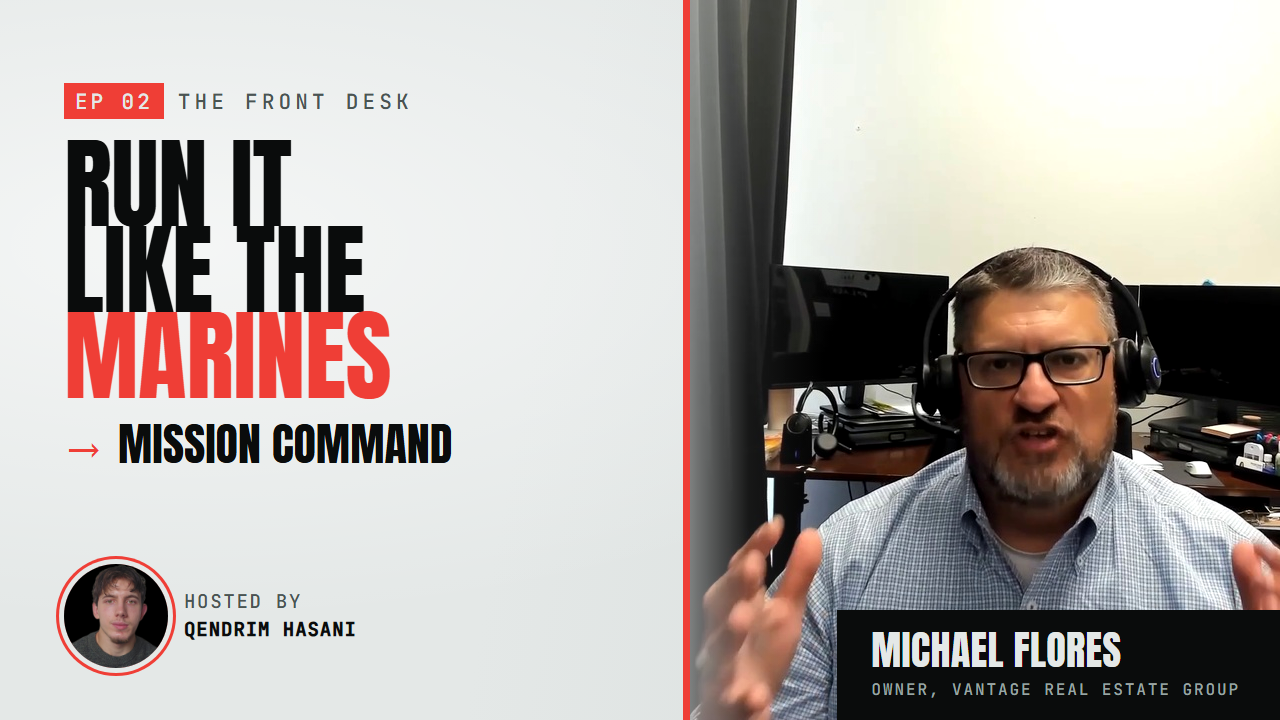
Michael Flores is a U.S. Marine Corps veteran and the owner and partner of Vantage Real Estate Group, powered by PLACE, in Katy, Texas, a suburb west of Houston. He was licensed in 2013, went full time in 2015, and his team has since helped more than a thousand families buy and sell homes.
In this episode he explains mission command, the leadership principle he brought out of the Marine Corps and runs the business on. He talks about the year Hurricane Harvey wiped out the business and his admin quit the same week. He names the niches the team is built around, military families and first responders first, then home ownership in the Hispanic community. And he is direct about where AI helps an agent and where it makes them look like an idiot.
What's in it
- Why closing the deal is not the end of the job
- From a restaurant background to a Keller Williams email that changed things
- Going full time with a mortgage, three kids, and seven pending sales
- The year Hurricane Harvey wiped out the business
- Phoning former team members to apologise for how he led them
- Military families, first responders and the Hispanic community
- Where AI helps an agent, and where it does not
In his words
You have a mission of what you want to accomplish, you execute the mission, and then you go back and figure out what it is that you could have done different or better. And I think that's where real estate agents and business owners miss it.
For us, it's military first, and what we call heroes, first responders, teachers. It's helping the Hispanic community with home ownership. It's helping first-time home buyers.
How are we implementing AI into our business and how do we rank on AI? We want to make sure we're ranking in all the little suburban cities that we work in. So, Katy, Fulshear, Cypress, all those cities that we work in, when people search for the top agent and they search for an agent, we want to rank in those.
If I could have a magic wand and get rid of all the false information out there in the industry, I think that would make life a lot easier for us. A lot of our time is spent educating away from what they heard.
Full transcript
Auto-generated from the episode audio, lightly corrected for names. Wording is as spoken, so it reads like speech rather than prose. Speaker labels are approximate: where one person talks for a while the captions break it into pieces, so a short interjection is occasionally folded into the other speaker's paragraph. The recording is the source of truth.
Michael
And that's the whole idea behind mission command, right? Is you have a mission of what you want to accomplish, you execute the mission, and then you go back and figure out what it is that you could have done different or better. And I think that's where real estate agents and business owners miss it is they don't go back and evaluate what they could have done better.
They're just happy that they got a closing. Well, that's fine. You got a closing, congratulations, but how did could you have done better?
Qendrim
Welcome to the second episode of the Front Desk podcast. Today, we have Michael Flores. And for those that don't know, can you tell them who you are and what do you do?
Michael
Sure. My name is Michael Flores. I am the owner and partner of Vantage Real Estate Group that's powered by PLACE here in a suburb of Houston, Texas known as Katy, Texas.
So, that's who I am and what I do.
Qendrim
So, can you tell us how did you get into real estate?
Michael
Well, man, so I always I was in corporate America at the time and I wanted to own my own business. And so, I was looking at franchises and I looked at different restaurants, I looked at different things. I have a restaurant background.
And I got an email from Keller Williams saying "Be an entrepreneur, own your own business, be a real estate agent." And so, I came to the informational session. And by the end of that session uh I knew that this was the path I wanted to go on. So, I signed up for some real estate classes during that session.
It was free to sign up with the classes, so I did. And and that's where I started my journey. And I just knew I wanted to be a real estate agent.
I didn't know all the opportunity the industry provided. I just knew I wanted to own my own business and I and that I thought real estate was a good way to do it.
Qendrim
When do you think that all started? Was it just a childhood long dream or was it someone that inspired you to want to own your own business?
Michael
No, man. I just hated corporate America.
Qendrim
Mhm.
Michael
I didn't want to be a part of it anymore. I got tired of the politics and the bull crap that goes on with it and I just wasn't good at navigating that. And so I really figured that to be successful for me, I needed to run my own business.
And I also thought about if I put in as much effort into my own business as I put into building corporate America and the companies I worked for, I would have much more benefit, you know, instead of working for a company 20 30 years and and working my tail off, I thought why not work my tail off for myself and build something that I can pass on to my children. And so that was really what inspired me along with the fact that I just really didn't like corporate America. I just didn't like being in it.
Qendrim
Of course. So not only was there something pulling you towards the goal of owning a business, but there was also something pushing you as well to leave corporate America. What are the steps did you take to go from corporate America to owning your own business and then going into real estate?
Michael
So as I said, I researched like different franchises, restaurants. And again, I got into real estate and when I started, I really started just I want to sell some houses and I want to replace the income I was making in corporate America. If I can replace that income, then I would be happy.
Michael
And so I built my website. I went out and got a you know, a DBA business title, came up with the company name and did all that, got hooked up with an attorney to create my business the correct way and do all that and an accountant and I started selling real estate and I really credit Keller Williams and the people that I know from Keller Williams that really helped me learn how to run a business versus just being an operator inside of a business, but really being a true business person. So it really is a mindset shift to realize that everything depends on you now.
Right? You can't just go into work, sit at your desk, and pretend to work. When you're an entrepreneur, when you're a business owner, you got to work.
Qendrim
And it's actually harder than working in corporate America.
Michael
You work a lot harder running your own business. So, that's kind of the process that I went through. And that was in 2013.
At the time, I was still in corporate America, actually, when I started my real estate business. I stayed working in corporate America at an organization. And I did that for 2 years while I built the real estate business so that I could replace my income.
And then in May of 2015, I turned in my notice and left. Gave it a 2-weeks notice, and I left that company. And June 2015 was my first day of being a solo real estate agent without um working for corporate America.
I no longer had an automatic paycheck coming in.
Qendrim
And how did you feel like leaving corporate America? Was it excitement? Was there worry?
Was there relief?
Michael
I think there was an I think it was almost all of that, to be honest with you, man. I mean, it was it was exciting. I had built a real estate business strong enough to where I knew I had closings coming up.
And so, I knew I could leave and I had money coming in. But it was still scary, right? You still have a mortgage and kids, and I had a mortgage and kids at the time, and and I still have mortgage and kids.
But it was nerve-racking, but I always knew that that I could do it, right? And I had a third-grade teacher, Miss Stanford, tell me one time that if I put my mind to good, I can do good things. And I've always remembered that.
So, I just told myself, "Just continue to work as hard as I did in corporate America. Treat it like a job. Treat it like I have a boss, even though I am the boss, and show up every day to work." And so, yeah, I was excited, but I was nervous, too.
And and and I'm a Christian, so I believe in in God. I believe in Jesus. And so, I really had a lot of faith in me to believe that I can do this.
But it doesn't mean I wasn't scared or nervous though.
Qendrim
Yeah. You leaving corporate America wasn't just immediately after things are okay now, business is going well. I'm guessing there was some times where it almost failed and you was just didn't know what to do.
You almost was doubting yourself. So in those moments, what got you through?
Michael
Yes. There are many times like that, sir.
Michael
I think what got me through was just remembering why I started this and going back to I started this to create a legacy for my kids, to create something that could outlive me. Right? And I remember growing up people telling me I would never be nothing or I remember people telling me I would never accomplish certain things.
And so I've had this chip on my shoulder my whole life and I still carry it today. And so because of that when times got tough when Hurricane Harvey wiped out my business or when my admin quit on the same day or when I woke up and I no longer had a team or when I was when I was not sure how I was going to make payroll I always went back to the fact that God gave me this vision and this desire. So because God gave me that vision and this desire, then I know God will help get me through this.
And so um I don't mean to kind of put that on your audience, but that's just really how I thought and that's how I believed. And I just went back to why did you start this? Have some faith.
And then I had to get to work. Right? I have a little rule that I follow is I can spend up to 30 seconds complaining or maybe even a minute complaining and whining, but then it's time to figure out what's the solution and how do I get to where I need to go.
And so that's how I've always gotten through it.
Qendrim
I'm I'm you must have tons of those, like, even systems that you follow every day that just keep you going even when you don't want to. Because unlike a job, like you said, in a normal job, you got that stability. You have someone, a boss, you have to listen to.
You have, like, someone to do the work for. But when you when you're working for yourself, you have to set your own rules and your own systems. So, what helped you one, know what rules to set for yourself, and then two, figure out how to implement them and actually follow follow through with them.
Michael
Yeah, so I would say that a couple things. Of course, there's some self-determination and discipline that goes on. However, no one succeeds alone.
So, I had phenomenal coaches in my life. So, I had phenomenal coaches like Fritz Pollard and Joe Bogar and Ben Kenny and Chris Suarez and just phenomenal mentors and coaches in my life that remind me of these things, right? And so, I think the people in your life that are involved in coaching you and mentoring you really matter.
That that really really matters. I also had some other coaches early on that their names escape me, but they did a phenomenal job as well. And then, I would say that the tool that that most people want to avoid, but is necessary and it sounds so basic, is a calendar.
Michael
And following that calendar, man, was was super important for me and it was something my coaches really talked about because I'm a little bit of a wild guy. Like, I'm at the time when I was new to real estate, I didn't have the discipline of a calendar. Corporate America forced that discipline, but when you're on your own, that doesn't you try to force yourself to a calendar.
But now I live by it, man. Like, if it's not on my calendar, it doesn't happen, right? It doesn't exist.
And so, I learned that early on taking a class called bold from Keller Williams. David Jones was my coach through that, and so I would say that the people that you surround yourself to coach you and mentor you are a big piece to that system. And then along with that, just looking simple like a calendar, something simple as a calendar and being disciplined to that can really changes your life, right?
Uh And then the actions that go what goes on the calendar are the actions you're supposed to be doing every day, and that's where that coach or mentor help you determine what that might look like for you as an as a business owner.
Qendrim
I know that you were in the Marines before corporate America, and use what you learned over there in real estate. Like all the rules you then learned that you're implementing them in real estate now as well. So, how did you manage to stick with them for so long and then still follow them through in a new industry where all the people might choose to not like choose the easy way and just do something that might benefit them, but you chose something that even though my it might not benefit you now, it still is better for everyone.
Michael
Yeah. So, I got out of the Marine Corps a long time ago. I got out of the Marine Corps in 1998.
So, it's been a long time, man. And I think what has allowed me to carry that through is that you know, you're a Marine for life, and the discipline, the integrity, the adaptability, the courage, the commitment that the Marine Corps teaches you, the brotherly love, sisterly love, cuz you know there's women in the Marine Corps, too. That carries you through, and you know, with the with the growth of social media, uh you know, when I got out of the Marine Corps, there's no social media.
But, as social media came on and Facebook and MySpace and all this stuff came on, we were able to reconnect with I was able to reconnect with people that I served with. And I think seeing those people through social media and messaging them and texting them and staying in touch with them, it reminds you of those times and the things you learned. And so, you know, the Marine Corps is is very much in my soul.
It's it's who I am, right? I'm not going to sit here and say I never I never went to war. I didn't fight over in the war.
And and yet, it's still in my soul. It's who I am. And being able to use that, the leadership I learned and then the mistakes I made.
I made a lot of mistakes in the Marine Corps and as a young guy. And so, being able to learn from those mistakes, learn from the leadership, going back to some of my leaders like Staff Sergeant Nails and and Lieutenant Meserve and and and Master Sergeant Robinson, like some of these guys that were my leaders, and remembering the things they taught me, right? And taking that taking those leadership lessons and then now teaching other people.
And and what leadership looks like and then also what courage looks like and what adaptability looks like. Those things are things that don't ever leave you. So, I appreciate you respecting that and mentioning that.
Michael
And and yet, the Marine Corps is not something that ever leaves you unless you force it out. It is who you are, it's who you become, and who you become will impact where you head it. And so, I don't know, I love it.
I love being a Marine and I love the what I learned in that and during that time. It was only 4 years, short time. And and yet, um it definitely has triggered or has impacted and led to where I'm at today.
Qendrim
I can tell that you're really like emotional about that. And it's really inspiring to see you talk about the Marines and just the people I've impacted your life like that.
Michael
I have many, many friends in the Marine Corps that went to Iraq. They went to Afghanistan. And I have many that made it back.
I have some some that I know of that didn't. And yet those guys and gals they retired. They did 20 years, 22 years, 23 years, 24 years in the Marine Corps.
And they gave their life to that. And so I just honor them. Even though I was only with them for four of those years.
Seeing them on social media, seeing the accomplishments they have in their life. One of them's getting ready to be an attorney. One of them is helps veterans today.
I mean there's all kinds of stuff they're accomplishing and it just means so much to me. So you're right. I do get a little emotional when I think of them.
Cuz we were 22, 23 years old. And now we're 50 year old. We're old farts now.
And to see the things they've accomplished is it it means a lot to me. Cuz those guys I know I know what they went through when I was with them. I can't imagine what they did for this country by going overseas and fighting in those wars.
So. What would you say you're doing in real estate now that's working for you that you wish you could have told you from when you was first getting into real
Michael
Man, that's a good question. What could I have told myself years ago? Probably I probably would have said do something easier.
No joke. Go do something easier, man. No, I'm joking.
Uh I think the way I led I think as a leader my development as a leader today and where how I was as a leader when I first started my real estate business is doesn't even compare. I think I would have told myself to lead differently. To think differently.
To have more compassion. To listen to my people better. Listen to the people that are in my company better.
I think I would have gone back and not been so rigid in my approach. To be a little bit more collaborative in my approach as a leader. As far as actions are concerned, I don't think I would have told myself to do anything different.
Like I had a lot of success early on, and that was because of the work I did. It's because of all the door knocks and all the calls and all the open houses and all the expired calls and all the letters I wrote and all the things I did as a young real estate agent. I don't think I would have changed anything.
I was very I'm very proud of what I accomplished as a young real As a leader, there's some things I look back on and think, man, I could have done that a lot different. So much so that I'll be honest with you, I've actually called people and apologized to them for my poor leadership back in those days because I think they deserve better. And the leader I am today is because of my partnership with PLACE, because of guys like Ben Kenny and Joe Bogar and and Chris War as and and other leaders, Holly and Nikki and Brian Gubernick and all these guys I'm surrounded by, guys and girls I'm surrounded by, they've helped me just become the leader I am today.
And I look back at 2018 and 2019 and 2020 and how I could have been different and yeah, I would have told myself to really grow as a leader back in those days and I and I didn't. I would I could have been better.
Qendrim
Uh principle I saw that you use now as mission command from the Mayans. Is that something you would advise all the real estate agents or real all the people in real estate industry to use as well?
Michael
Yeah, I think you got to always go back and you got to look at your mission and what am I looking to accomplish? What is my niche? What is the goal of this mission?
And then always evaluate that and go back and say to yourself, okay, now that we've completed that, whether it's selling a house or helping a buyer or helping an investor, whatever you're doing in real estate, you always got to go back and say, what could I have done better for that seller? What could I have done better for that buyer? What could I have done better during that open house?
How could I have done this situation better or different? And that's the whole idea behind mission you have a mission of which you want to closing. Congratulations, but how did Mhm.
So, that by helping everyone, you're helping yourself as well.
Michael
That's right.
Qendrim
You talk about people a lot, and how important do you think is having the right people working with you, and then finding the right clients to work with as well?
Michael
So, it's it's super important to have the right people on your team, We have three administrative people on our team. Our operations manager's name is Savannah, and then we have two people from our virtual assistants. Um one is Christine, one is M, and I will say the people you choose to partner with, it just matters so much in your organization.
You're If you're a real estate agent or an operator or a business owner, your administrative team is your culture. They are the background of backbone of your culture. They are the spine of your organization.
How your administration team interacts and functions will 100% impact your company. And I don't think I learned that fast enough, to be honest with you. Um you know, whether how they get their job done is based on how well the admin supports them.
And it's the administration department that supports them, our operations department. And then it just comes down to hiring the right people to be part of your business, whether they're real estate agents or sales people. For our For our organization is real estate agents.
And so, it's hiring the right people that fit your culture, that have the same drive, who have the goal that they want to accomplish, and really coming down to creating that avatar, right? Like who is my ideal agent to partner with? Who is the people that I want to be in business with?
And so we turn around we turned away a lot of people. We also have turnover in organization like any other sales organization, but I will tell you that the ones that are here, the ones that we hire and we partner with and who stay long-term, those are the ones that I'm super grateful for. And I wake up every day asking myself, how do I make how do I make this better for them?
How do we make this organization so good that they hit their goals and they're able to accomplish everything they want in life? I mean, that's that's what it's about,
Qendrim
How important do you think it is saying no to the young people and to the person that they might seem good on paper, like they get the results, but when you meet them, their character just doesn't align with your culture. How important do you think it is saying no to that person?
Michael
Critical. It's critical, my friend.
Michael
Like you cannot let poison into your team, into your business, into your organization. I don't care how good they sound, how good they look, how many results they get, if they are poison to your culture, if they are poison to your ethics and to your morals, and if they go against what your vision and your values are in your organization, they can't be part of it.
Michael
And we can love them. We can care about them. We can say, "Hey, you're awesome.
You're just not a fit for me."
Qendrim
Right.
Qendrim
What are you working towards and where do you think the real estate industry is going towards?
Michael
So, what we're working towards in our organization, I'll start small then go bigger. We're working towards really three main things, I would say. Number one is really getting good at a niche niche, not a niche a niche.
You know, what is our niche? What are we focused on? Where are we headed?
Where are we going? As far as that one niche, right? What could it be?
For us, it's military, first and uh what we call heroes, first responders, teachers. It's helping the Hispanic community have with home ownership. It's helping first-time home buyers.
It's helping the luxury buyer and seller, relocation buyer or seller. So, those are the niches that we're really I mean, there's others, but those are the main ones for us, right? The second thing is really how are we implementing AI into our business and how do we rank on AI?
We want to make sure we're ranking in all the little suburban cities that we work in, right? So, Katy, Fulshear, Cypress, all those cities that we work in, we when people search for the top agent and they search for an agent, we want to rank in those. So, it's really we're really focused on utilizing AI within our company, but also making sure that we do things to to rank.
The third thing we're doing really moving forward is just focusing on each individual hitting their goals. The real estate market is not uh as strong as it was during COVID. It doesn't mean that our goals are impossible.
So, we just have to become really uh really fine-tuned and execute at the highest level so that each agent on our team hits their business, right? Or makes their makes their goals. As far as where the real estate industry's headed, man, you know, I'm not the smartest real estate agent in the world, so I will tell you I think it's I think it's headed to for the next couple years Gary Keller says that it's going to look like it is today, right?
About 4 million sales across the country, transactions across the country. I think that the days on market will continue to grow in real estate, especially in the Houston market. I think price points will continue to rise and at a 1 or 2% clip.
And I think that it'll continue to be very much a balanced market, at least in Houston. I don't know what it'll look like across country. I do think we're headed towards a much more of a balanced a buyer's market as an as a just as an industry in general.
And I think that we'll see AI utilized in more of our tools as far as talk like giving us data and information. And I think the sellers and buyers will have more data and information for them. So, I think the agent that embraces AI within the business doesn't mean it takes over everything.
It just means that you let it supplement your business. And then the agent that really understands where the sellers and buyers are looking. Right?
If you look at the age group now a lot of 25, 27, 28-year-olds are starting to get into the real estate market and wanting to buy. And so the way they see the world is much different than people in my generation the 50, 55-year-olds. Right?
They use Google a lot. They use AI a lot. And so I think the real estate industry needs to get to where we embrace it a little bit more and understand what the consumer's looking for when it comes to that.
So, we'll see where where it ends up. But that's that's my thought in it.
Qendrim
I feel like everyone and the dog is talking about AI right now. So, what would you say to like the people in real estate, the agents who might be scared of it, who might be scared that AI might replace them. Or they might just be against using AI.
Would you push them towards using it? Or what would you say to them?
Michael
Yeah. AI is not going to replace you. Real estate will always be a human game.
They will always need humans. It'll always be about relationships. I don't care what anybody tells you.
In my opinion, we'll find out in 10 years from now. Let's grab this podcast and see what happens. But but I don't think AI will ever take over the human error of it, the human aspect of it.
If you're going to use AI to do silly chat GPT photos or use AI to try and recreate yourself to do like these fake video models where everybody can tell that it's not you. Then just don't use it. You're going to look like an idiot.
You're going to Everybody can tell it's not you. We know it's not you. It's It's obvious.
Right? It doesn't even sound like you. So, I would say though if you're going to use AI to help you streamline your processes and systems to make you more efficient.
If you're going to use AI to figure out how to rank yourself higher. If you're going to use AI to help you with scripts or maybe video scripts or use AI to help you with ideas, then okay. Even if you're going to use some of those silly photos that chat GPT put on there, that's fine.
But you can't be the only thing you do. Right? You got to do blogs.
You got to do podcasts like you're doing. You got to do YouTube. You got to do social media and you got to be authentic.
People want authentic. And the problem with AI right now is real estate agents are using it to replace their own selves. Instead of going and shooting the video themselves, they're trying to create some robot that looks like them and sounds like them to create the video.
And in in actuality, everybody knows it's not you. And it's not authentic. And in today's world, people still want genuine and they want authentic.
They just want you to be you. And you'll And you'll build a relationship with people who enjoy you for you. Right?
And And that's the problem. So, I would say if you're not using it, you're going to fall behind. I'm not saying you can't have a good business without it, but you are going to fall behind because our organizations like me and like bigger organizations that are using it will be more efficient and streamlined and be able to move faster than you will if you're not using it.
And you know, you'll have to decide if you want to use it for those silly videos or any of that. And then another question, if you had the hypothetical magical sword would slash away any of your business problems, what problem would you choose?
Michael
That's a good question. Give me a second to think about that one. To re- to remove any of my uh business issues.
Hm. I think I'd like if I had a genie that can remove any issues, it would be all the false information that's out there in real estate. That there's so much false information that are put out by the so-called experts, by real estate agents, by whoever.
And so, if I could have a magic wand and get rid of all the false information out there in the industry, I think that would make life a lot easier for us. Cuz a lot of our time is spent educating away from what they heard on Yahoo money or CNN or Fox News or whatever sources they use to or some silly agent getting on a video and saying that, you know, it's a buyer's market. Well, it depends.
Where I sell, some areas is a buyer's market, some areas are a balanced market, and some areas are actually listing or seller markets. But an agent gets on there and doesn't explain that. And so, people hear this one thing and they go off with it.
So, let's get rid of all the false information and let's just tell the truth. And the truth depends on where that house is located is whether it's a buyer's market, seller's market, or balanced market. And where that buyer is looking depends on whether it's a buyer's market, seller's market, or balanced market.
So, let's get a little bit more specific. Let's tell the truth. And let's stop putting these headlines out that just get just clickbait bullcrap that really is false information.
And then, as a last question, for someone starting out in real estate, what's the one thing you'd tell them to focus on that would get them the most results starting out?
Michael
Lead generate. Talk to 20 people every day about real estate. 20 people every day about real estate.
That's it. Do that every day, 5 days a week. It could be in person or over the phone.
Talk to 20 people every day about real
Qendrim
Thank you for coming on the podcast.
Qendrim
Thank you to Michael Flores for coming on the podcast. Thank you, Michael. Any last words?
Michael
No, man. Get out there and get it. And if you have any questions, you can reach out to me.
Uh my number is 281-889-9352. If you ever want to give me a call or email me or look me up, I'm on social media, as well.
Qendrim
Thank you. And that's the end of the episode.
Episode 03 is being booked now